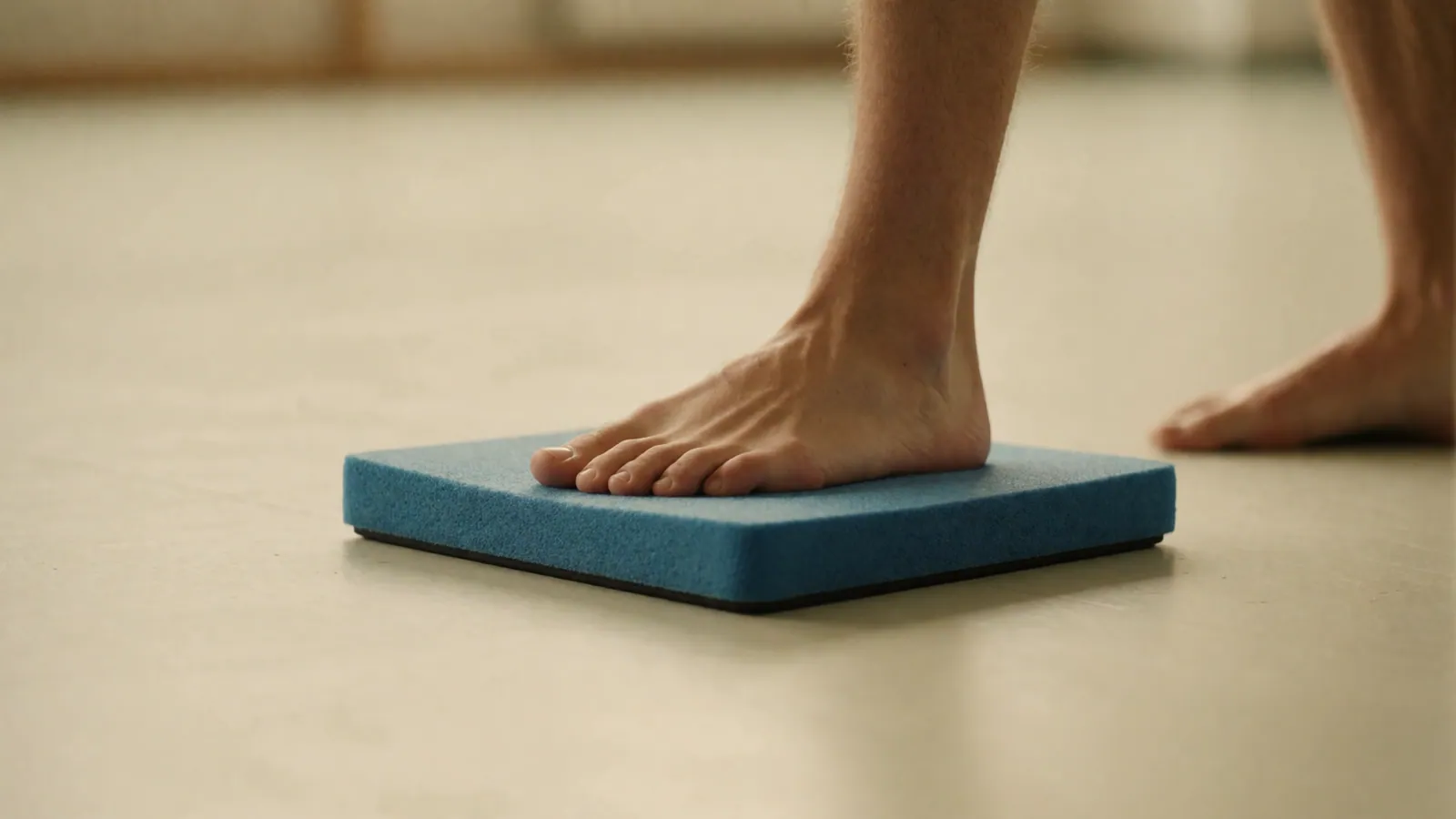
Joints, muscles and tendons
Ankle and foot pain
The sprain that never fully settled is the commonest thing we see here, and it stops being a ligament problem long before it stops being a problem.
An ankle sprain damages ligaments, and ligaments heal. What frequently does not recover on its own is the proprioception — the ankle's sense of where it is in space — and that is what decides whether you roll it again.
Which is why so many people have an ankle that is fine most of the time and gives way unpredictably on uneven ground eighteen months later. The ligament healed. The control did not come back, because nobody trained it.
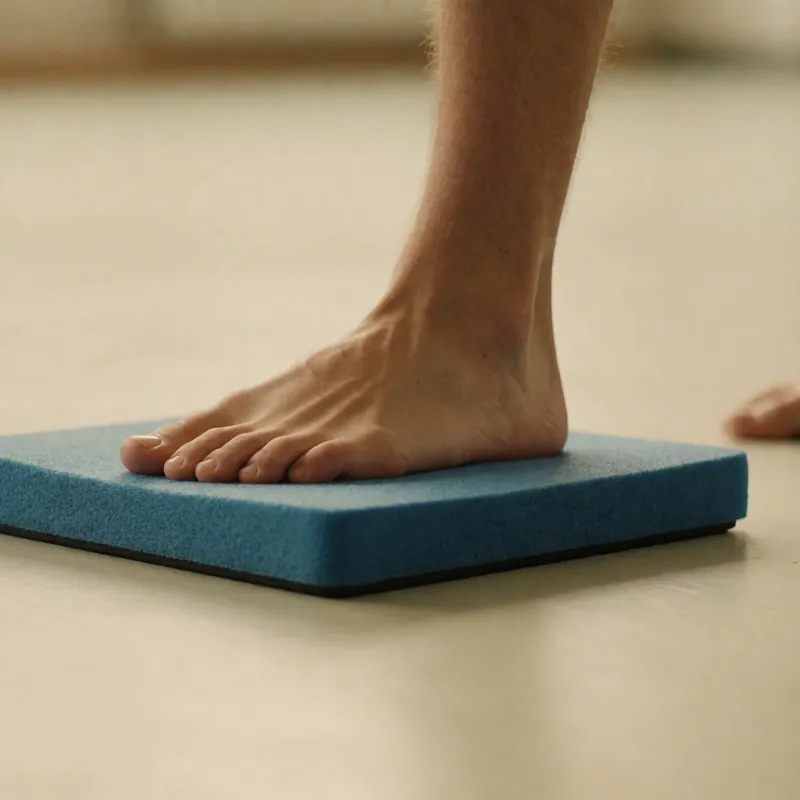
Why balance training is the actual treatment
Balance and proprioceptive retraining after an ankle sprain has good evidence for reducing recurrence, and it is the component most reliably skipped. People do the range work, get comfortable walking, and stop — at exactly the point where the useful part begins.
It is also the part that cannot be done from a printed sheet, because progression depends on what you can currently hold and for how long, and because the whole point is to challenge the system to the edge of failure safely.
The other things that arrive here
Achilles tendon pain, which is a load problem and follows the same tendon rules as the elbow and the heel: progressive loading, months not weeks, uncomfortable at first.
Post-fracture stiffness after a boot or a cast, where range comes before strength and both take longer than people expect.
And foot pain that turns out to be coming from the ankle, the calf or the way the hip is controlling the leg on landing.
Return to sport
By test, not by date. Single-leg balance held with eyes closed, hop distance symmetry, and the movement that caused the injury performed at speed while somebody watches. Those are written down at the start so nobody negotiates them in week six.
An ankle that feels fine walking is not an ankle that is ready to cut on grass, and the gap between those two states is where reinjuries live.
Nothing here is a promise that treatment will work. Nothing on this site is a promise that treatment will work. Physical therapy has good evidence behind it for a great many musculoskeletal problems and poor evidence for a few of the things it is sold for, and we would rather tell you which of those you have than take the appointment either way. We publish no success rate, no star rating and no before-and-after photographs, because a clinic that chooses which outcomes to show is not reporting outcomes.
Included as standard
How we treat this
Balance retraining as the substance
The component with the evidence for preventing recurrence, and the one most reliably skipped.
Progression to the edge of your control
Which is why this cannot be done from a printed sheet — the challenge has to be calibrated to what you can currently hold.
Tendon problems loaded, not rested
Achilles pain follows the same rules as every other tendon: progressive load, months rather than weeks.
Range before strength after immobilisation
A cast costs range and muscle. Both come back, in that order, and slower than anybody expects.
Written return-to-sport criteria
Balance held with eyes closed, hop symmetry, and the injuring movement at speed. Agreed at the start, not in week six.
The chain above examined
Foot and ankle pain frequently reflects what the hip is doing on landing.
When to make an appointment
Signs this is worth an assessment
- You sprained it months ago and it still does not feel trustworthy.
- It gives way on uneven ground or kerbs, unpredictably.
- You have sprained the same ankle more than twice.
- There is stiffness and swelling that has not fully resolved.
- Achilles pain that is worst on the first steps of the day.
- You have come out of a boot or cast and the ankle will not bend properly.
Ankle & foot — how long a course usually takes
- A typical course after an ankle sprain or for chronic instability. Balance retraining is the part that prevents the next one and the part most people skip.6 – 12 visits
This is a typical number of visits for this problem, not a quote and not a promise. You get an estimate specific to you, in writing, at the first appointment, and we reassess against the same measurements at visit four rather than at visit ten — so a course that is not working gets changed or stopped instead of extended. What each visit costs is published on the pricing page: $190 for the initial evaluation and $140 for a treatment visit if you are paying yourself, or your plan's copay if you are not. We do not sell blocks of visits in advance.
Questions we are actually asked
Ankle & foot — frequently asked
Why does my ankle keep giving way after a sprain?
Because the ligament healed and the proprioception did not come back. Your ankle's sense of where it is in space is what protects it on uneven ground, and it does not recover on its own — it has to be retrained. That is the component most people skip, which is why recurrent sprains are so common.
How long after a sprain should I still be doing exercises?
Longer than you would think. Comfortable walking arrives well before the control does, and stopping at that point is precisely how people end up with an ankle that gives way eighteen months later. A typical course here is six to twelve visits with a home programme running past the last one.
Do I need a scan for an ankle sprain?
Usually not. There are well-established clinical rules for deciding when an X-ray is warranted after an ankle injury, and most sprains do not meet them. Inability to bear weight, or bony tenderness in specific places, are the things that change the answer — and we screen for those.
Is Achilles pain treated with rest?
No. Achilles tendon pain responds to progressive loading and not to rest, which reliably produces a weaker tendon and the same problem on return. It takes months and the first fortnight is uncomfortable, which is true of every tendon.
When can I go back to sport?
When you pass the tests rather than when a date arrives: single-leg balance held with eyes closed, hop distance symmetry, and the movement that caused the injury performed at speed. They are written down at the first appointment so nobody renegotiates them later.
Related conditions
Often seen alongside this

Plantar heel pain
Worst on the first steps out of bed, better once you are moving, back again in the evening. Slow to fix and very responsive to loading.
6 – 12 visits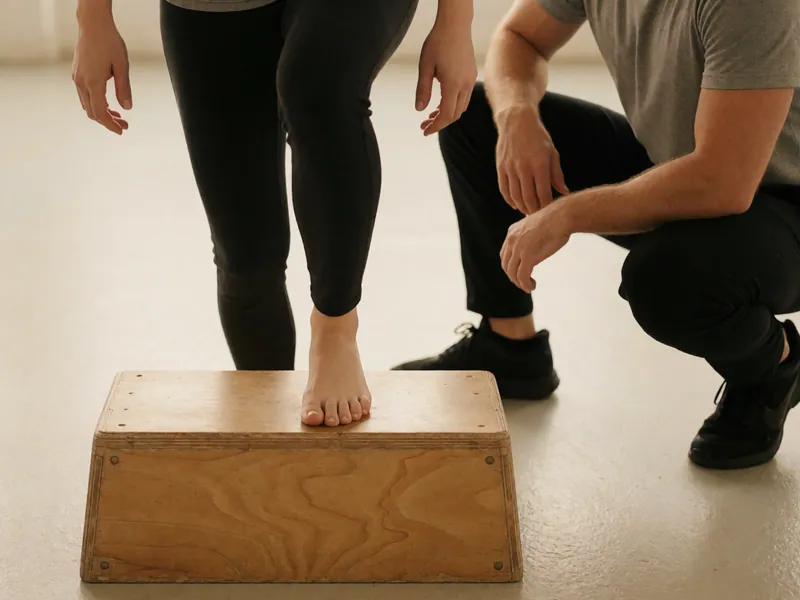
Knee pain
Stairs, kneeling, running, or the knee that hurts because of what the hip is not doing. All four get a different programme.
6 – 14 visits
Sports injury
Return is a test you pass, not a date you reach. We will tell you what the test is at the first appointment.
10 – 24 visits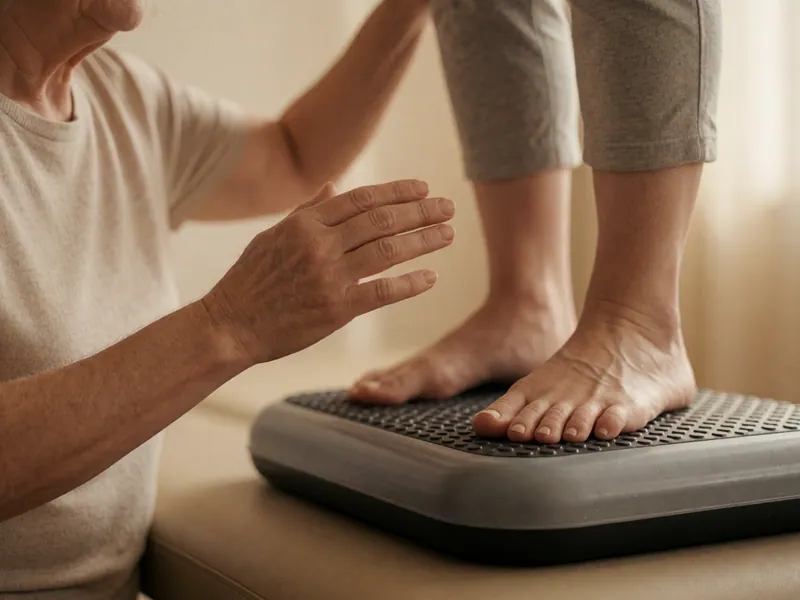
Balance & falls
Falling is not a consequence of age. It is a consequence of specific, measurable and largely trainable deficits, and we measure them.
12 – 24 visitsSixty minutes, one to one, with the therapist you chose
Book an appointment
The booking page shows each therapist's own diary rather than a generic grid, so a slot you can see is a slot that is genuinely free. Most people do not need a doctor's referral to start — New York's direct access law runs to ten visits or thirty days — though Workers' Compensation, No-Fault and Medicare each need one from the first visit. If you are not sure which of those you are, telephone and we will work it out before you book.