Joints, muscles and tendons
Tennis and golfer's elbow
Almost nobody who has it plays either sport. It is a load problem in the forearm tendons, and rest alone reliably fails to fix it.
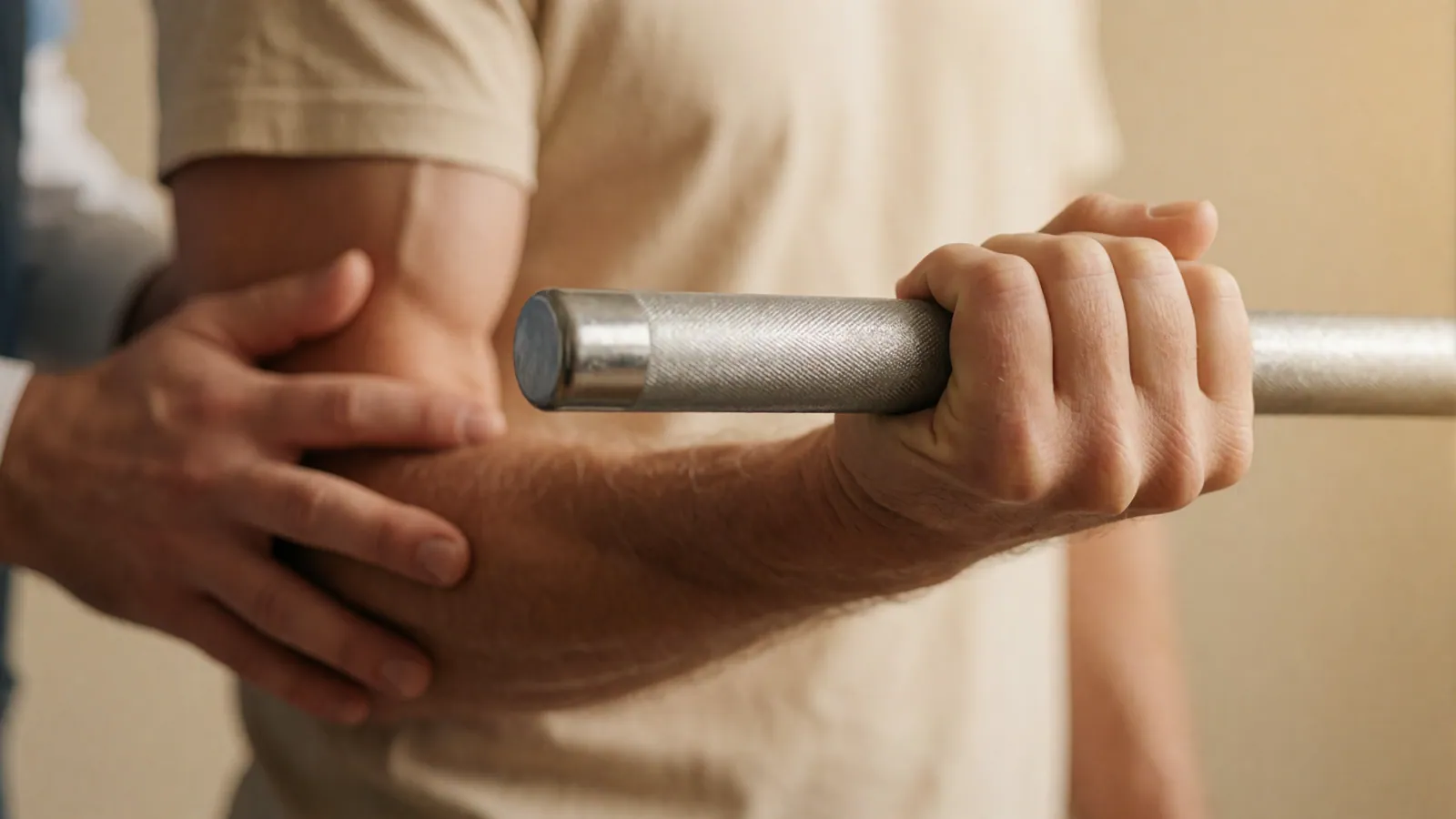
Pain on the outside of the elbow (tennis elbow) or the inside (golfer's elbow) is tendon pain at the point where the forearm muscles attach. It typically arrives after a change in load — a new job, a renovation, a baby who now needs carrying, a return to the gym — rather than after an injury.
The universal first treatment is rest, and it universally disappoints. Rest reduces the pain while you are resting and produces a weaker tendon that hurts again the moment you resume. What changes the tendon is load.
Why the first fortnight is uncomfortable
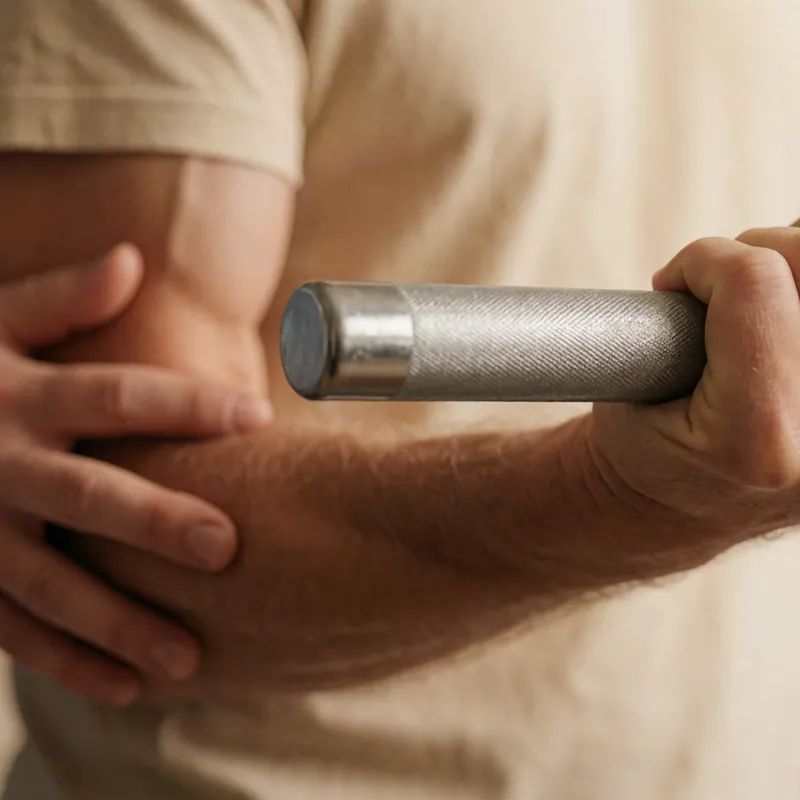
Tendon rehabilitation involves loading a tendon that hurts, deliberately, at an intensity that produces adaptation. Some discomfort during and shortly after is expected and is not a sign of damage — the rule is about how it settles, not about whether it hurts at all.
That is a difficult sell and it is why so many self-directed attempts stop in week two. Being told in advance that this is the expected experience, with a clear rule for what would be too much, is a large part of what the supervision is for.
What we change besides the exercise
The grip. A great deal of elbow tendon load comes from how hard and how long you grip, and small changes — a fatter handle, a different tool, a break every twenty minutes — reduce the daily dose substantially.
The specific task. If it started when you started tiling, the tiling has to be modified for a while. There is no exercise programme that outruns an unchanged provocation.
The neck, occasionally, because a proportion of elbow pain is referred and does not respond to anything done to the elbow.
Things people try
Straps and braces reduce symptoms for some people during activity. They are a comfort measure that buys you working time and they do not treat the tendon.
Injections give short-term relief and, for elbow tendinopathy specifically, the evidence suggests worse outcomes at a year than exercise. We will say so if you ask.
And ultrasound, which we do not use here — the hour is better spent on the loading.
The machines are not the treatment. Ultrasound, most electrical stimulation and mechanical traction do not appear on our treatment plans as a matter of routine. The World Health Organization's 2023 guideline recommends against therapeutic ultrasound in routine care for chronic low back pain, NICE recommends against offering it for back pain with or without sciatica, and the Cochrane review found a small effect that was not clinically important. These machines survive because they bill well and need no clinician in the room, which is precisely the reason to be suspicious of a plan built around them.
Included as standard
How we treat this
Progressive tendon loading
The intervention with the evidence. Heavy enough to adapt, with a clear rule for what would be too much.
The provocation modified
No exercise programme outruns an unchanged daily load. The tiling, the toolbag, the grip all get looked at.
Grip strategy
Handle thickness, grip duration and break frequency reduce the daily dose substantially and cost nothing.
Expectation setting at visit one
The first fortnight is uncomfortable. Being told that in advance is why people finish the course rather than abandoning it.
The neck screened
A proportion of elbow pain is referred and responds to nothing done at the elbow.
Honest advice on injections
Short-term relief, and for elbow tendinopathy the evidence suggests worse outcomes at a year than exercise.
When to make an appointment
Signs this is worth an assessment
- Gripping, lifting a kettle or shaking hands produces a distinct sharp pain at the elbow.
- It started after a change in activity rather than after an injury.
- You have rested it for several weeks and it returned as soon as you resumed.
- It has lasted more than a month.
- It is starting to affect your work or your ability to carry things.
- You have had an injection that helped for a few weeks and then wore off.
Elbow tendon pain — how long a course usually takes
- A typical course. Strengthening under load is the treatment with the best evidence and it is uncomfortable for the first fortnight, which is why so many courses are abandoned early.6 – 12 visits
This is a typical number of visits for this problem, not a quote and not a promise. You get an estimate specific to you, in writing, at the first appointment, and we reassess against the same measurements at visit four rather than at visit ten — so a course that is not working gets changed or stopped instead of extended. What each visit costs is published on the pricing page: $190 for the initial evaluation and $140 for a treatment visit if you are paying yourself, or your plan's copay if you are not. We do not sell blocks of visits in advance.
Questions we are actually asked
Elbow tendon pain — frequently asked
How long does tennis elbow take to get better?
Six to twelve visits here, over several months. Tendons adapt slowly. The first fortnight of loading is uncomfortable, which is expected rather than a warning sign, and it is the point at which most self-directed attempts are abandoned.
Why hasn't resting it worked?
Because rest reduces the pain while you rest and produces a weaker tendon that hurts again the moment you resume. Tendons adapt to load, not to its absence. This is the single most useful thing to understand about the condition.
Should I get an injection?
It gives short-term relief, and for elbow tendinopathy specifically the evidence suggests worse outcomes at a year compared with exercise. If pain is severe enough to prevent you doing the loading at all, it may have a place as a bridge — that is a conversation with a physician, and we will give you our honest view.
Do elbow straps work?
They reduce symptoms during activity for some people, which is genuinely useful if it lets you keep working. They do not treat the tendon and a strap worn indefinitely is a strap substituting for the training.
Is it normal for the exercises to hurt?
Some discomfort during and shortly after loading is expected in tendon rehabilitation. The rule is about how it settles rather than whether it hurts at all, and we will give you that rule specifically rather than leaving you to guess.
Related conditions
Often seen alongside this
Wrist & hand
Carpal tunnel, thumb base arthritis, de Quervain's and the stiff hand after a cast. Small joints, high stakes for daily life.
6 – 12 visits
Shoulder pain
Five structures in a small space, all of which hurt in roughly the same place. The examination is what separates them.
8 – 14 visits
Neck pain
Desk necks, phone necks, slept-badly necks and the ones that are actually a shoulder. Telling them apart is most of the first appointment.
5 – 10 visits
Work injury
Rehabilitation aimed at the job you actually do, inside the Workers' Compensation rules that govern how many visits you get.
12 visits, then PARSixty minutes, one to one, with the therapist you chose
Book an appointment
The booking page shows each therapist's own diary rather than a generic grid, so a slot you can see is a slot that is genuinely free. Most people do not need a doctor's referral to start — New York's direct access law runs to ten visits or thirty days — though Workers' Compensation, No-Fault and Medicare each need one from the first visit. If you are not sure which of those you are, telephone and we will work it out before you book.