Back, neck and spine
Herniated and bulging discs
The phrase that frightens people most and predicts their pain least. Here is what the report actually describes, what it does not, and what changes the outcome.
A disc herniation is a portion of the disc's inner material pushing through its outer wall. When that material sits against a nerve root it can produce genuine, severe leg or arm pain. It is a real thing and it can be miserable.
It is also extremely common in people who feel completely well. Bulges and degeneration turn up in large proportions of pain-free adults and the proportion rises steadily with age, which means finding one on your scan does not establish that it is the reason you hurt. Both of those facts are true at once and holding them together is the whole of the first appointment.
What the words on your report mean
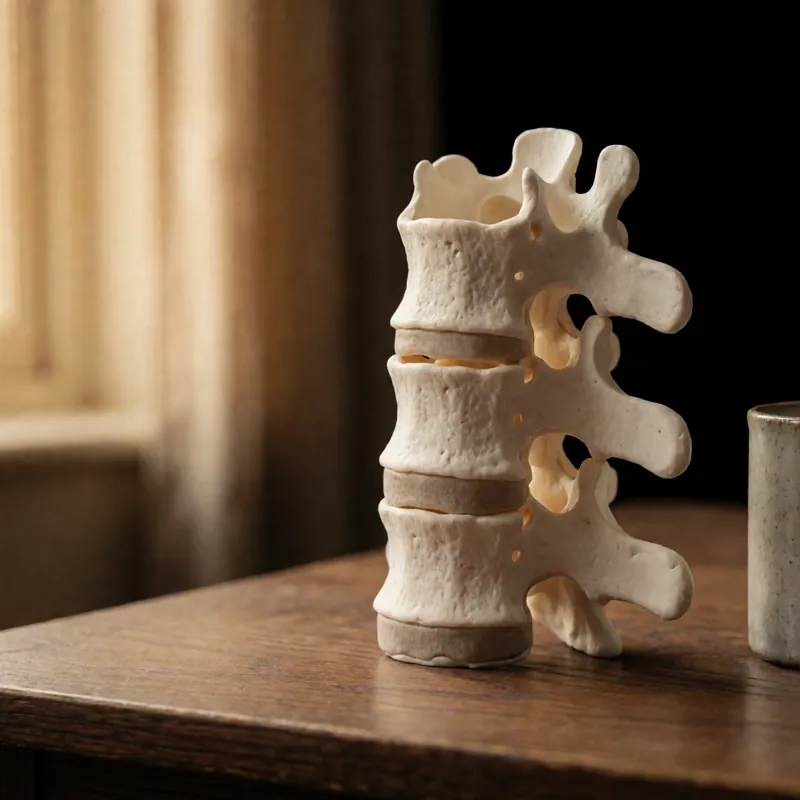
“Bulge” describes a shape — the disc wall pushing out uniformly. Extremely common, frequently asymptomatic, and not a tear.
“Protrusion”, “extrusion” and “sequestration” describe increasing degrees of material coming through. Counter-intuitively, the larger and more displaced herniations frequently resolve faster, because the body is more efficient at reabsorbing material that has fully escaped.
“Degenerative disc disease” is not a disease. It is the radiological description of a disc that has aged, which every disc does, and by sixty most people have it whether their back has ever hurt or not.
Why most of these do not need an operation
Herniated material reabsorbs. It is a slow biological process measured in months rather than weeks, and it happens in the majority of cases without anybody operating. Treatment during that period is aimed at what you can do meanwhile — keeping you moving, protecting the rest of you from deconditioning, and managing the symptoms while the tissue does its own work.
That is not an argument that surgery is never right. It is right when there is progressive weakness, when cauda equina symptoms appear, and sometimes when a well-run conservative course has genuinely failed a person whose life has stopped. We will tell you when we think the surgical opinion is the right next step, and a practice that never says that is not being conservative, it is being commercial.
What we actually do
Find a directional preference if there is one and give it to you to use several times a day. For many disc presentations this is the highest-value thing in the first fortnight.
Manage the sitting. A lumbar disc under load is usually worst in sustained flexion, and a job that involves eight hours of it needs a specific plan rather than an instruction to sit up straight.
Then rebuild, gradually, over the months the tissue takes. Trunk and hip strength, tolerance for the positions you have been avoiding, and a return to lifting done deliberately rather than by accident on a bad day.
The story people tell themselves
This is the part of a disc problem that outlasts the disc problem. Somebody is handed a report full of alarming words, concludes their spine is structurally fragile, and spends the next decade protecting it — which produces exactly the deconditioning that makes the next episode worse.
Undoing that is a real part of the treatment and it is not achieved by being told to stop worrying. It is achieved by loading the thing progressively and discovering it holds.
A scan describes a structure; it does not describe your pain. A scan describes a structure at a moment; it does not describe your pain. Disc bulges, degeneration and rotator cuff tears turn up in large numbers of people who have no symptoms at all, and their prevalence rises steadily with age in people who feel completely well. So a report can be entirely accurate and still not be the reason your back hurts. We read your imaging, we take it seriously when it changes the plan, and we will not let a phrase from a radiology report become the story you tell yourself about your spine.
Included as standard
How we treat this
Your report read, and put in proportion
We take the imaging seriously and we will tell you honestly whether the examination tells the same story as the scan.
Directional preference established early
Where one exists it is the most useful tool you have, and it is yours to use at home rather than something that happens here.
Neurological screening at every stage
With an explicit threshold for escalation: progressive weakness or any bladder or bowel change goes straight to a physician.
A plan for the sitting
Because a lumbar disc and an eight-hour desk job need a specific arrangement, not an instruction about posture.
Honest timescales
Reabsorption is measured in months. We will tell you what the course usually looks like rather than what you would prefer to hear.
We will say when surgery is worth asking about
Progressive weakness, cauda equina symptoms, or a genuinely failed conservative course. A practice that never recommends a surgical opinion is not being careful.
When to make an appointment
Signs this is worth an assessment
- A scan has reported a herniation and nobody has explained what it means for what you should do.
- Pain travels below the knee or below the elbow and has lasted more than a fortnight.
- Sitting is much worse than standing, and long journeys have become a problem.
- You have started avoiding lifting anything at all, and the list of avoided things is growing.
- You have been offered surgery and would like a considered view on whether to wait.
- You have noticed weakness rather than only pain — this one should be seen promptly.
Herniated disc — how long a course usually takes
- A typical course for a symptomatic lumbar disc without progressive weakness. Most herniations reduce on their own over months; treatment is aimed at what you can do meanwhile.8 – 16 visits
This is a typical number of visits for this problem, not a quote and not a promise. You get an estimate specific to you, in writing, at the first appointment, and we reassess against the same measurements at visit four rather than at visit ten — so a course that is not working gets changed or stopped instead of extended. What each visit costs is published on the pricing page: $190 for the initial evaluation and $140 for a treatment visit if you are paying yourself, or your plan's copay if you are not. We do not sell blocks of visits in advance.
Questions we are actually asked
Herniated disc — frequently asked
Do I need surgery for a herniated disc?
Usually not. Most herniations reabsorb over months and most people recover without an operation. What changes the answer is progressive weakness, any change in bladder or bowel control, or a genuinely failed conservative course in somebody whose life has stopped. We will tell you when we think a surgical opinion is the right next step.
Can physical therapy heal a herniated disc?
Physical therapy does not push the material back in, and any clinic telling you it can is describing something that does not happen. What it does is manage symptoms, keep you moving, find the movements that ease it, and rebuild strength and tolerance while the body reabsorbs the material on its own timescale.
Is a bulging disc the same as a herniated disc?
No. A bulge is the disc wall pushing out uniformly and is extremely common in people with no symptoms; a herniation is inner material coming through the wall. Radiology reports use both words precisely and patients often read them as the same thing, which is where a good deal of unnecessary fear comes from.
How long until I feel better?
A typical course here is eight to sixteen visits, and the biological process of reabsorption runs for months beyond that. Progress usually shows first as the pain retreating up the limb rather than as the intensity dropping.
Should I avoid bending and lifting forever?
No, and the belief that you should is frequently more disabling than the disc. Protecting a back indefinitely produces exactly the deconditioning that makes the next episode worse. There is a period of modification early on, and then a deliberate, graded return to loading — which is the part that actually changes your risk.
Related conditions
Often seen alongside this
Sciatica
Pain down a leg is a symptom, not a diagnosis. Four different things cause it and they do not respond to the same treatment.
8 – 16 visits
Low back pain
The most common reason anybody walks through this door, and the condition where the gap between what sells and what works is widest.
6 – 12 visits
Spine surgery
Discectomy, decompression or fusion. Three different operations with three different sets of things you may not yet do.
12 – 24 visits
Spinal stenosis
When walking distance shrinks and leaning on a shopping trolley helps, the mechanism is specific and so is the treatment.
10 – 20 visitsSixty minutes, one to one, with the therapist you chose
Book an appointment
The booking page shows each therapist's own diary rather than a generic grid, so a slot you can see is a slot that is genuinely free. Most people do not need a doctor's referral to start — New York's direct access law runs to ten visits or thirty days — though Workers' Compensation, No-Fault and Medicare each need one from the first visit. If you are not sure which of those you are, telephone and we will work it out before you book.