
Joints, muscles and tendons
Shoulder pain
Five structures in a small space, all of which hurt in roughly the same place. The examination is what separates them, and shoulders are slow — meaningful change is measured over months.
Pain on the outside of the upper arm can come from the rotator cuff tendons, the subacromial space, the joint itself, the joint at the top of the shoulder, or the neck. All five refer into a similar area and the person experiencing it cannot tell which, because pain is a poor localiser.
The examination can. It takes twenty minutes and it decides the whole plan, which is why we would rather spend the first appointment on it than start treating something on the balance of probabilities.
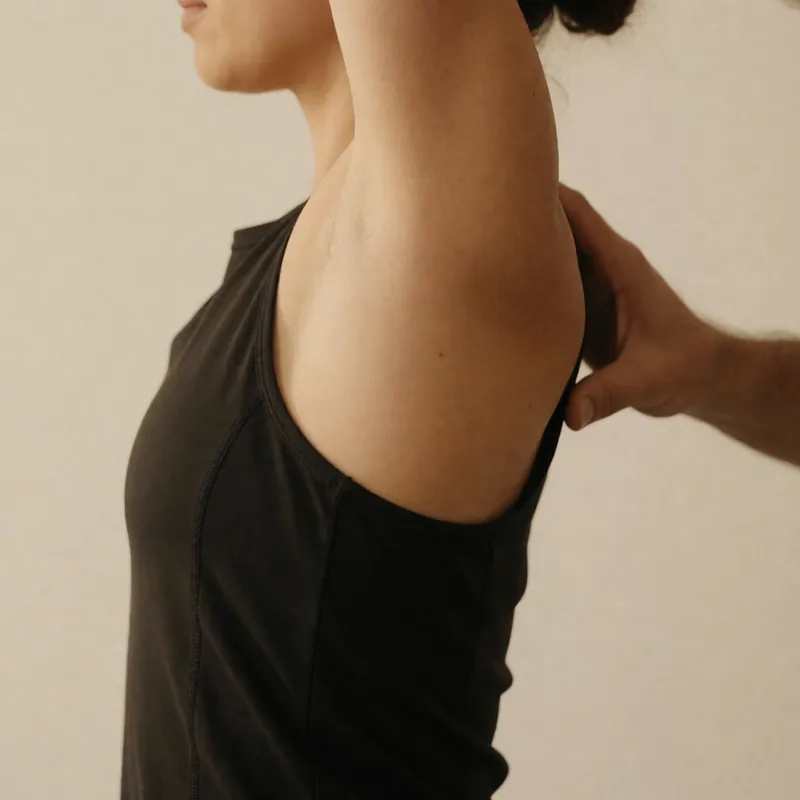
Where the neck comes into it
A meaningful share of shoulder pain is referred from the neck, and it responds to nothing you do to the shoulder. The screening question is whether neck movement reproduces it and whether the shoulder moves through full range without symptoms — if so, the shoulder is a bystander.
This is one of the commonest reasons a course of shoulder treatment does nothing, and it is entirely avoidable at the first visit.
Why shoulders are slow
Tendon tissue adapts on a timescale of weeks to months, not days. A shoulder that has been progressively irritated for six months is not going to be comfortable in a fortnight, and a clinic promising that is either treating something else or is going to disappoint you.
Eight to fourteen visits is a typical course and the useful progress markers are functional: reaching a high shelf, sleeping on that side, putting a coat on without planning it. Those change before the pain fully goes, and they are what we measure.
The treatment
Load, progressively, in ranges you tolerate, moving into the ranges you currently do not. Loaded exercise has the best evidence for most non-operative shoulder pain and it is the bulk of the hour.
Manual therapy and range work where stiffness is genuinely limiting — a means to the loading rather than the treatment.
And attention to the shoulder blade, because a cuff working against a scapula that is not positioning itself has a harder job than it needs.
A scan describes a structure; it does not describe your pain. A scan describes a structure at a moment; it does not describe your pain. Disc bulges, degeneration and rotator cuff tears turn up in large numbers of people who have no symptoms at all, and their prevalence rises steadily with age in people who feel completely well. So a report can be entirely accurate and still not be the reason your back hurts. We read your imaging, we take it seriously when it changes the plan, and we will not let a phrase from a radiology report become the story you tell yourself about your spine.
Included as standard
How we treat this
The neck screened as a source
Because referred pain from the neck responds to nothing you do to the shoulder, and this is the commonest reason shoulder treatment fails.
Five structures distinguished, not guessed
Twenty minutes of examination at visit one, because the plan for each is different.
Functional markers rather than pain scores
Reaching the high shelf, sleeping on that side, getting a coat on. These change before the pain does.
Loaded exercise as the substance
The intervention with the best evidence for non-operative shoulder pain, progressed on what you achieved.
Scapular work where it earns it
A cuff working against a poorly positioned shoulder blade has a harder job than it needs.
Honest timescales at visit one
Shoulders take months. We would rather tell you that than have you conclude at week three that it is not working.
When to make an appointment
Signs this is worth an assessment
- You cannot sleep on that side, and have not been able to for weeks.
- Reaching overhead or behind your back has become something you plan around.
- It has been sore for more than a month and is not steadily improving.
- A scan reported a tear and nobody explained what that does and does not mean.
- You have pain in the shoulder but full, comfortable movement — this may be your neck.
- You have been given a resistance band and a sheet, done it, and nothing changed.
Shoulder pain — how long a course usually takes
- A typical course for shoulder pain of mechanical origin. Shoulders are slow: meaningful change is measured over six to twelve weeks, not over a fortnight.8 – 14 visits
This is a typical number of visits for this problem, not a quote and not a promise. You get an estimate specific to you, in writing, at the first appointment, and we reassess against the same measurements at visit four rather than at visit ten — so a course that is not working gets changed or stopped instead of extended. What each visit costs is published on the pricing page: $190 for the initial evaluation and $140 for a treatment visit if you are paying yourself, or your plan's copay if you are not. We do not sell blocks of visits in advance.
Questions we are actually asked
Shoulder pain — frequently asked
How long does shoulder pain take to get better?
A typical course here is eight to fourteen visits, and meaningful change is measured over six to twelve weeks rather than over a fortnight. Tendon tissue adapts slowly. The markers that move first are functional — sleeping on that side, reaching a high shelf — and they move before the pain fully goes.
Could my shoulder pain be coming from my neck?
Frequently, yes. If your shoulder moves through full range comfortably but still aches, and neck movement reproduces it, the shoulder is a bystander. It is one of the commonest reasons a course of shoulder treatment achieves nothing, and it is screened at the first appointment.
Do I need a scan for shoulder pain?
Usually not initially. Rotator cuff tears are common in people with no symptoms at all and become more common with age, so finding one does not establish that it is causing your pain. A scan is genuinely useful when surgery is being considered or when the presentation does not behave mechanically.
Should I rest my shoulder?
Complete rest usually makes it worse, and stiffness is harder to treat than soreness. What we modify is the specific provoking load for a period, while loading the tissue in ranges you tolerate. Doing nothing at all is the version that leaves you stiff and weak in three months.
Do you use ultrasound on shoulders?
No, not as routine treatment. The evidence for it is poor and the hour is better spent on loaded exercise, which is the intervention that actually changes tendon capacity.
Related conditions
Often seen alongside this
Rotator cuff
A tear on a scan is not automatically the tear causing your pain, and loaded exercise beats rest for most of them.
10 – 18 visits
Frozen shoulder
The one condition where we will tell you at the first visit roughly how long it will take, and that the honest answer is measured in seasons.
12 – 24 visits
Neck pain
Desk necks, phone necks, slept-badly necks and the ones that are actually a shoulder. Telling them apart is most of the first appointment.
5 – 10 visits
Cuff repair
A repaired tendon has to be protected before it can be loaded. Getting the order wrong is how a good repair fails.
20 – 32 visitsSixty minutes, one to one, with the therapist you chose
Book an appointment
The booking page shows each therapist's own diary rather than a generic grid, so a slot you can see is a slot that is genuinely free. Most people do not need a doctor's referral to start — New York's direct access law runs to ten visits or thirty days — though Workers' Compensation, No-Fault and Medicare each need one from the first visit. If you are not sure which of those you are, telephone and we will work it out before you book.