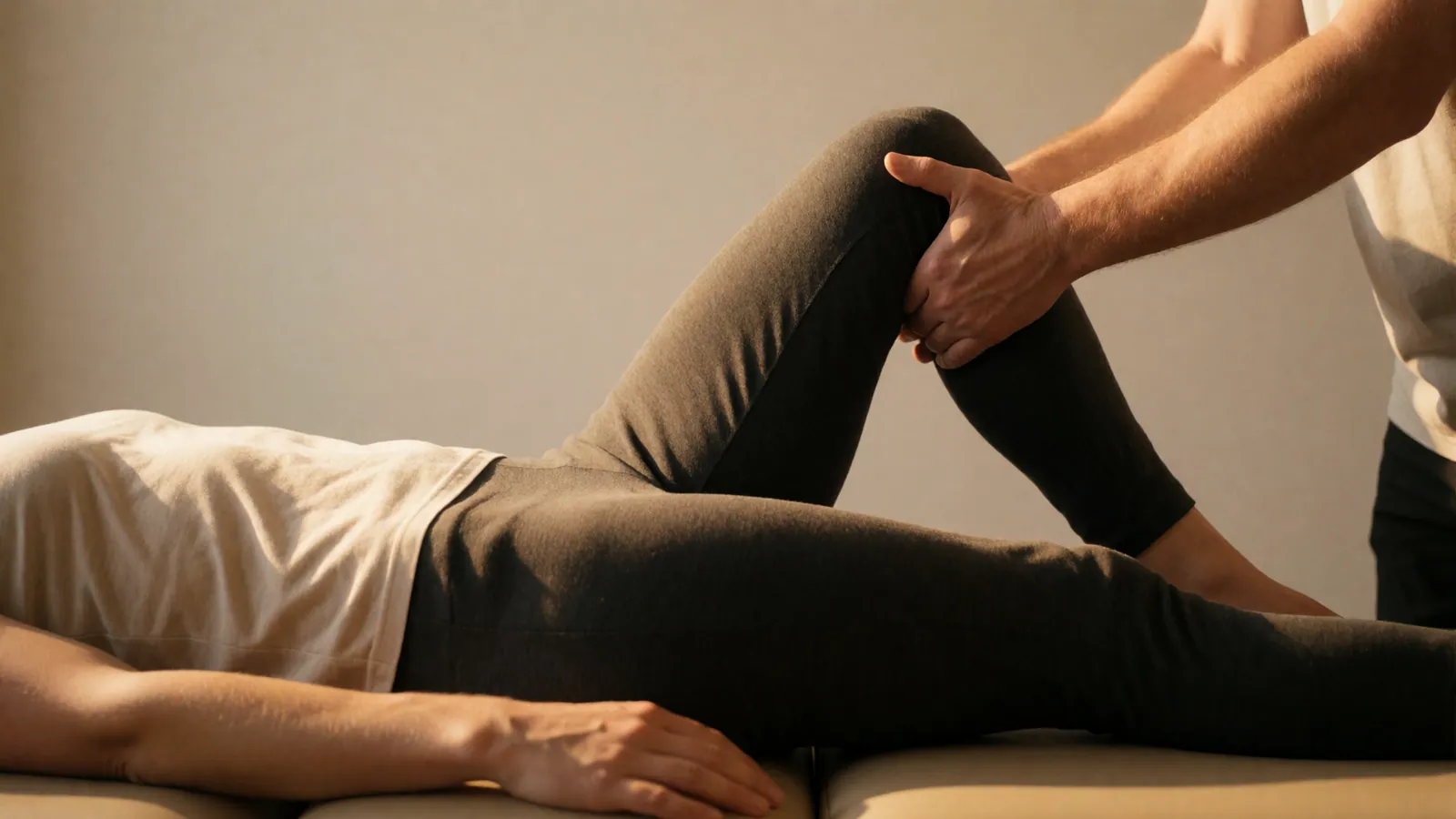
Joints, muscles and tendons
Hip and groin pain
True hip joint pain is felt in the groin. Pain on the outside of the hip is usually a tendon — and it is made worse by exactly the stretch most people are given for it.
Two very different problems arrive under this heading. Pain deep in the groin, worse on rotation and on getting out of a car, is usually the joint itself. Pain on the outside of the hip, tender to lie on, worse on stairs and after walking, is usually gluteal tendinopathy — a tendon at the side of the hip that has been overloaded.
The second is extremely common, frequently misdiagnosed as bursitis, and reliably made worse by the standard self-treatment, which is stretching. Getting this one right changes people's lives quite quickly.
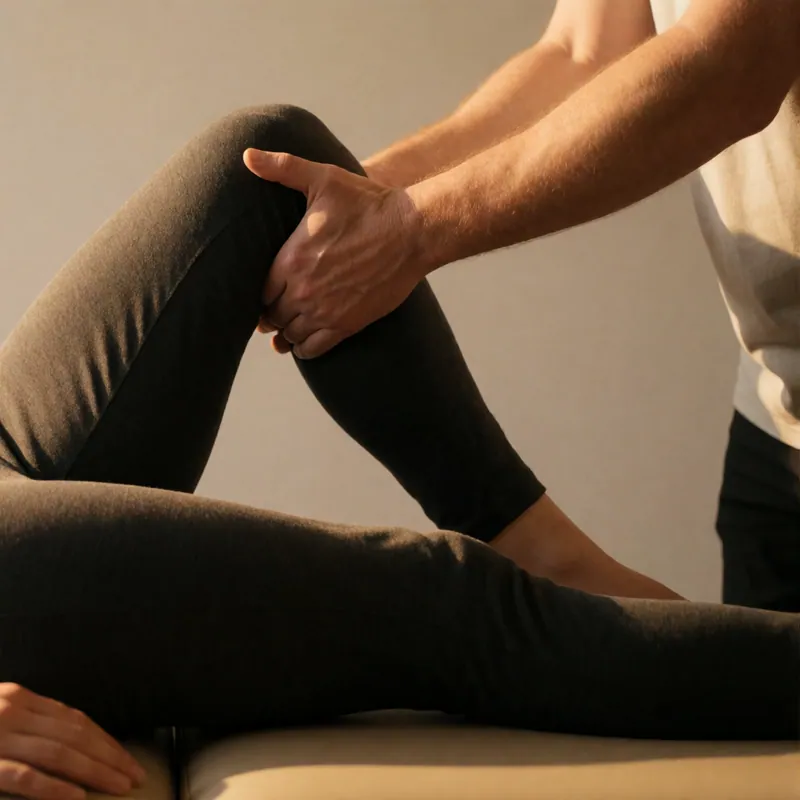
Why stretching a gluteal tendon backfires
The gluteal tendons are compressed against the bone when the hip is brought across the midline. Every classic outside-hip stretch — crossing the leg over, the figure-four, sleeping with the top knee dropped forward — puts the tendon into exactly that compressed position.
So the stretch that feels like it should help is loading the irritated tissue in the way it least tolerates, several times a day. People do it diligently for months and get worse, and conclude their hip is deteriorating.
The first thing we change is usually not an exercise, it is that list of positions: how you stand, how you sit, how you sleep. That alone frequently produces noticeable change inside a fortnight.
Then load it
Tendons respond to progressive load, and gluteal tendons are no exception. Isometric work first while it is irritable, then progressive resistance in positions that do not compress it, building towards single-leg work.
It takes months rather than weeks and the first fortnight is uncomfortable. That is tendon rehabilitation and it is the same story as the elbow and the heel.
Hip osteoarthritis
Groin pain, stiffness first thing, and restricted rotation. Exercise therapy is first-line care and has a good evidence base for improving pain and function, without changing the joint itself.
Where a hip genuinely warrants replacing, it is a very good operation and we will say so. Prehabilitation beforehand measurably improves the recovery, and it is the cheapest thing you can do about a date that is six months away.
The machines are not the treatment. Ultrasound, most electrical stimulation and mechanical traction do not appear on our treatment plans as a matter of routine. The World Health Organization's 2023 guideline recommends against therapeutic ultrasound in routine care for chronic low back pain, NICE recommends against offering it for back pain with or without sciatica, and the Cochrane review found a small effect that was not clinically important. These machines survive because they bill well and need no clinician in the room, which is precisely the reason to be suspicious of a plan built around them.
Included as standard
How we treat this
Groin versus outside-hip separated at visit one
They are different problems with different treatment, and outside-hip pain is the one most often mislabelled.
The position list changed first
How you stand, sit and sleep. For gluteal tendinopathy this alone frequently produces change inside a fortnight.
Stretching stopped where it is doing harm
The classic outside-hip stretches compress the tendon in exactly the way it least tolerates.
Progressive tendon loading
Isometrics while irritable, then resistance in non-compressive positions, building to single-leg work.
Honest tendon timescales
Months, not weeks, with an uncomfortable first fortnight. That is what tendon rehabilitation is.
Prehabilitation where a replacement is coming
Strength before the operation measurably improves recovery after it.
When to make an appointment
Signs this is worth an assessment
- You cannot lie on that side at night without it aching.
- Pain on the outside of the hip, worse on stairs and after walking.
- Deep groin pain that catches when you get out of a car.
- You have been stretching it for months and it is worse rather than better.
- You were told it was bursitis and given an injection that helped briefly.
- Standing with your weight on one leg is uncomfortable within a minute.
Hip pain — how long a course usually takes
- A typical course for gluteal tendinopathy or hip osteoarthritis. Load management does more here than any hands-on technique, and we will be direct about that.8 – 16 visits
This is a typical number of visits for this problem, not a quote and not a promise. You get an estimate specific to you, in writing, at the first appointment, and we reassess against the same measurements at visit four rather than at visit ten — so a course that is not working gets changed or stopped instead of extended. What each visit costs is published on the pricing page: $190 for the initial evaluation and $140 for a treatment visit if you are paying yourself, or your plan's copay if you are not. We do not sell blocks of visits in advance.
Questions we are actually asked
Hip pain — frequently asked
Why does the outside of my hip hurt?
Usually gluteal tendinopathy — a tendon at the side of the hip that has been overloaded. It is frequently labelled bursitis, it is tender to lie on, and it is worse on stairs and after walking. It responds well to load management and progressive loading, and badly to stretching.
Why does stretching make my hip worse?
Because the classic outside-hip stretches bring the leg across the midline, which compresses the gluteal tendons against the bone — exactly the load an irritated tendon least tolerates. Doing that several times a day is why so many people get steadily worse while following the advice diligently.
How should I sleep with hip pain?
On your back, or on the other side with a pillow between the knees thick enough to stop the top leg dropping across the midline. That single change frequently produces noticeable improvement inside a fortnight, and it is usually the first thing we alter.
Can physical therapy help hip arthritis?
Yes, as first-line care. Exercise therapy has a good evidence base for improving pain and function in hip osteoarthritis. It does not change the joint. Where a replacement is genuinely warranted it is a very good operation, and prehabilitation beforehand measurably improves the recovery.
How long does gluteal tendinopathy take?
Eight to sixteen visits here, over several months. Tendons adapt slowly and the first fortnight of loading is uncomfortable. The position changes usually help sooner than the exercise does.
Related conditions
Often seen alongside this
Knee pain
Stairs, kneeling, running, or the knee that hurts because of what the hip is not doing. All four get a different programme.
6 – 14 visits
Hip replacement
Faster and less painful than the knee, and the mistake here is stopping too soon because walking feels normal before the muscle has come back.
10 – 18 visits
Low back pain
The most common reason anybody walks through this door, and the condition where the gap between what sells and what works is widest.
6 – 12 visits
Strains & tears
Hamstrings, calves and groins. The reinjury rate is high and it is high because people return to sport on how it feels rather than on what it can do.
6 – 14 visitsSixty minutes, one to one, with the therapist you chose
Book an appointment
The booking page shows each therapist's own diary rather than a generic grid, so a slot you can see is a slot that is genuinely free. Most people do not need a doctor's referral to start — New York's direct access law runs to ten visits or thirty days — though Workers' Compensation, No-Fault and Medicare each need one from the first visit. If you are not sure which of those you are, telephone and we will work it out before you book.